Table of contents
Open Table of contents
Introduction
For many years, pip has been the go-to tool to manage dependencies in Python, and it is still working just fine, but as long as you are working in some backend, microservices or big enough projects, you know that pip can be a little underperforming.
That’s why today I want to show some alternatives that me and my team have been working with in addition to pip, let’s talk about Poetry, uv, and how they compare to pip.
The baseline: pip + venv
This is the classic stack:
python -m venv .venv
source .venv/bin/activate
pip install -r requirements.txt
This is simple, explicit, and just works. But not without some limitations:
- There is no strong dependency resolution (it depends on how we generate the
requirements.txtfile). - No clear model of dependencies for development or production environments (usually you need to create two different requirement files).
- There is no version control management for the project (like in
pyproject.toml).
And the one that worries me the most and took more time for me and my team to fix it:
Dependency confusion in pip
This problem appears when we have private dependencies (for example in an internal registry or private index) that do not exist on PyPI under the same name.
If someone publishes a package on PyPI with that exact name, pip may install the public package first instead of the private one, depending on how index-url and extra-index-url are configured.
For example, imagine our company has an internal package:
company-utilsIf that package name does not exist on PyPI and someone publishes a package with that name there, pip could resolve the dependency from PyPI instead of our internal registry.
This issue became widely known a few years ago through several dependency confusion attacks affecting large companies.
In practice, common mitigations include:
- Reserving internal package names on PyPI.
- Using a private index as the only
index-url(and this is not always possible, especially if the internal package needs external packages). - Or using dependency management tools that enforce stricter resolution rules (this is where Poetry or uv come along)
It’s not something we run into every day, but when working with internal packages, it’s definitely one of those things you need to consider.
Poetry: packaging and all-in-one dependency management
Poetry arrived with a very clear proposal: unify dependency management, lockfiles, and packaging in one modern tool centered around pyproject.toml.
Instead of working with requirements.txt, setup.py, and other extra files, Poetry tries to give us a single and more coherent workflow.
What it does well
- Robust dependency resolution.
- A reproducible
poetry.lockfile. - Clear separation between main and development dependencies.
- A natural workflow for publishing packages.
- A project structure centered around
pyproject.toml.
Example:
poetry init
poetry add fastapi
poetry add pytest --group dev
poetry install
In more structured backend projects, this gives us more order and predictability.
What does not fully convince us
- Performance: dependency resolution can be slow in large projects, and our project was BIG.
- Virtual environments are managed automatically, and sometimes we want more control.
- The learning curve is a bit higher for teams that are already very used to
pip.
In my experience, Poetry is ideal when we are developing a library or we want something formal and reproducible. Or just when we care a lot about project structure.
That said, for day-to-day backend services, sometimes Poetry can feel a bit heavier than what we actually need.
uv: speed and modern pragmatism
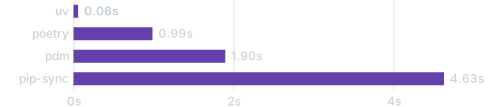
uv, developed by Astral (the same people behind Ruff), is written in Rust and has the goal to be extremely fast and compatible with the existing ecosystem.
And when I say fast, I really mean fast.
What we like about uv
- Much faster installs than
piporPoetry. - Compatibility with
requirements.txt. - Support for lockfiles.
- It can replace
pip,pip-tools, andvirtualenv.
Simple example:
uv venv
uv pip install fastapi
Or even:
uv pip install -r requirements.txtWithout radically changing our workflow.
A quick comparison
So, if I had to summarize it very simply, I would put it like this:
- pip is the standard baseline: universal, familiar, and good enough for many simple cases.
- Poetry is the structured choice: great when packaging, locking, and project organization are your main concerns.
- uv is the pragmatic performance choice right now: fast, modern, and much easier to introduce incrementally.
Which one would I choose?
For me, the answer usually looks like this:
- If I am working on a small or legacy project and I do not want to change much,
pip+venvis still fine. - If I am building a reusable package or I want a more formal workflow, Poetry is still a strong option.
- If I am working on backend services, CI pipelines, or projects where speed matters a lot, I would probably choose
uv.